WORLD TOILET
DAY
SAFE
SANITATION FOR HEALTH, DIGNITY AND EQUALITY
2026 THEME:
SANITATION AND GENDER EQUALITY | EVERYONE DESERVES A SAFE, PRIVATE AND
ACCESSIBLE TOILET
3.4 BILLION
people
globally lacked safely managed sanitation in 2024
354 MILLION
people
worldwide still practised open defecation
20%
of Nigeria’s household population practised open defecation
Why toilets
matter
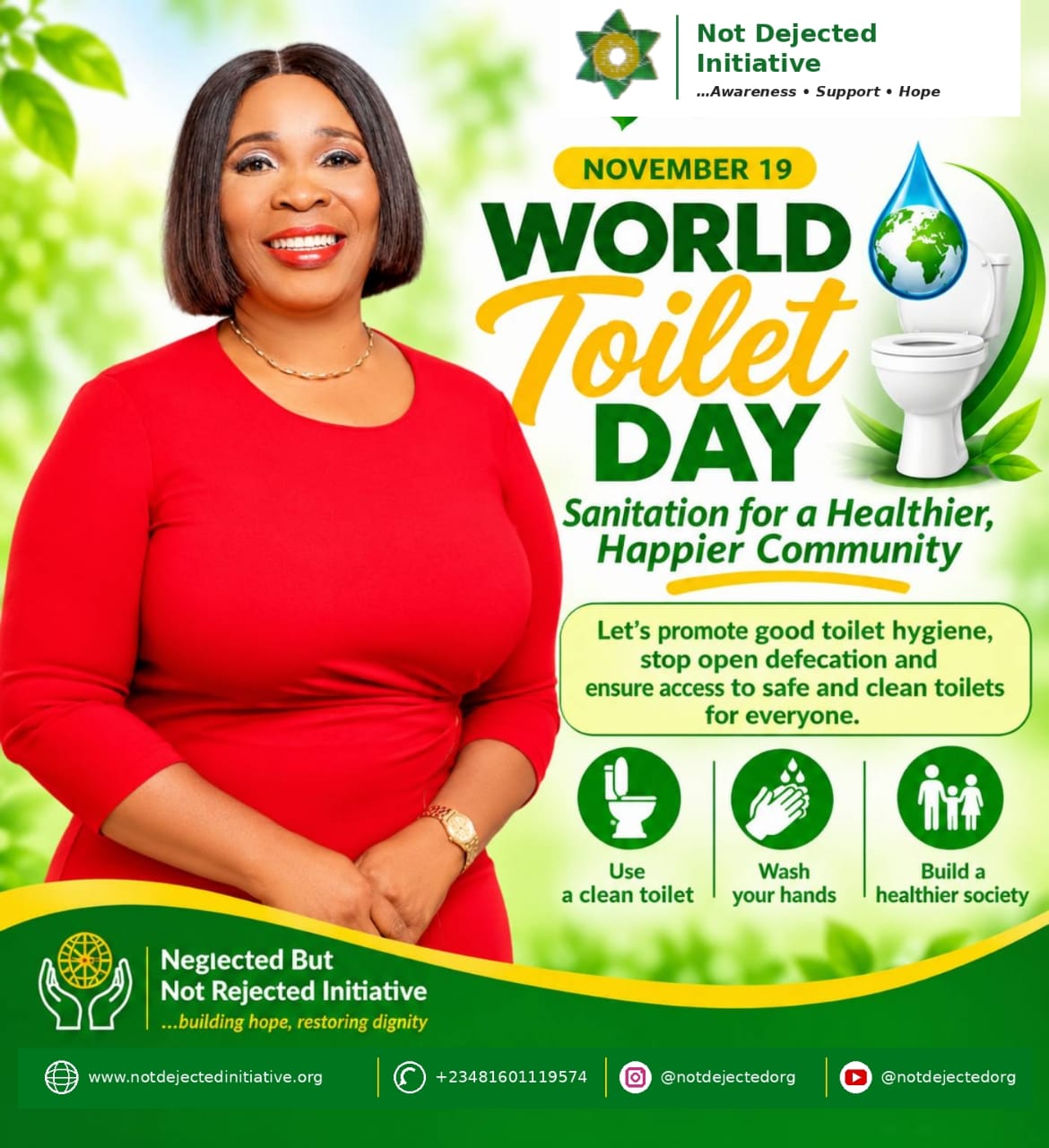
World Toilet
Day is observed every 19 November to draw attention to the global sanitation
crisis and encourage action. Sanitation is more than having a toilet: it
includes safely containing, emptying, transporting, treating and disposing of
human waste. When any part of this chain fails, people and the environment
remain at risk (United Nations, n.d.; UN-Water, n.d.).
Safe sanitation
protects drinking-water sources, reduces exposure to disease-causing germs and
supports privacy, safety and human dignity. It is an essential public service
and a key part of achieving Sustainable Development Goal 6: clean water and
sanitation for all (United Nations, 2015; World Health Organization [WHO] &
United Nations Children’s Fund [UNICEF], 2025).
Sanitation
in Nigeria: progress, but unequal access
The 2024
Nigeria Demographic and Health Survey reported that 49% of the household
population had at least basic sanitation. Access differed sharply by location:
63% in urban areas compared with 38% in rural areas. It also varied by
household wealth, from 21% in the lowest wealth quintile to 84% in the highest.
These gaps show how poverty and where people live can determine whether they
have access to a decent toilet (National Population Commission [NPC] [Nigeria]
& ICF, 2025).
A toilet
count alone does not tell the whole story. Services must be functional, clean,
private, accessible and supported by safe waste management. A toilet that is
shared, unsafe, inaccessible or not connected to appropriate waste treatment
may not provide adequate protection (WHO & UNICEF, 2025).
Who is most
affected?
Women and
girls can face particular risks when toilets are not private, secure or
equipped with water, soap and menstrual-waste disposal options. In schools,
workplaces and public spaces, inadequate facilities can affect attendance,
participation and confidence. Children, older people and persons with
disabilities also need facilities designed around their safety and access
needs.
Poor
sanitation can spread diarrhoeal diseases and intestinal infections,
contaminate water and soil, increase healthcare costs and reduce productivity.
Flooding and drought can further damage sanitation systems, making
climate-resilient planning and regular maintenance essential (WHO & UNICEF,
2025; UN-Water, n.d.).
FROM
AWARENESS TO ACTION
World Toilet
Day should inspire year-round improvements—not just a one-day celebration.
What needs
to change?
Improving
sanitation requires coordinated action by governments, communities, schools,
health institutions, civil society and private service providers. Priorities
include:
• Make
toilets affordable and available, especially for low-income and rural
households.
• Upgrade
and maintain toilets in schools, markets, health facilities and public spaces.
• Provide
gender-responsive, disability-inclusive facilities with privacy, lighting,
water, soap and safe menstrual-waste disposal.
• Ensure
human waste is safely contained, emptied, transported and treated to prevent
pollution and disease.
• Plan for
floods, droughts and other climate risks so sanitation services remain safe and
reliable.
• Use
accurate local data to track access, functionality, open defecation and
inequalities.
How can you
take part?
Talk openly
about sanitation and why it matters. Promote toilet and handwashing hygiene at
home, school and work. Support community clean-up and awareness activities,
report unsafe or poorly maintained public facilities, and encourage
decision-makers to invest in inclusive toilets and safe waste treatment.
A toilet is
not a luxury. It is essential to health, safety and human dignity.
Sustainable
Development Goal 6 calls for adequate and equitable sanitation and hygiene for
all, an end to open defecation, and attention to the needs of women and girls
and people in vulnerable situations. World Toilet Day helps bring these goals
into public discussion. Lasting progress, however, depends on sustained funding,
strong institutions, community participation, regulation and monitoring
throughout the year (United Nations, 2015).
References
National
Population Commission (NPC) [Nigeria], & ICF. (2025). Nigeria demographic
and health survey 2024. https://www.health.gov.ng/wp-content/uploads/2025/10/NDHS-2024-Final-Report_Disseminated17102025.pdf
United
Nations. (n.d.). Background: World Toilet Day.
https://www.un.org/en/observances/toilet-day/background
UN-Water.
(n.d.). World Toilet Day. https://www.unwater.org/our-work/world-toilet-day
United
Nations. (2015). Transforming our world: The 2030 Agenda for Sustainable
Development. https://sdgs.un.org/2030agenda
World Health
Organization, & United Nations Children’s Fund. (2025). Progress on
household drinking water, sanitation and hygiene 2000–2024: Special focus on
inequalities. WHO/UNICEF Joint Monitoring Programme.
https://data.unicef.org/resources/jmp-report-2025/